Kevin Jackson - fine artist - THEMES, SERIES AND TRAVELS:
|




. . . . p a g e s . u n d e r . c o n s t r u c t i o n . . . .

|
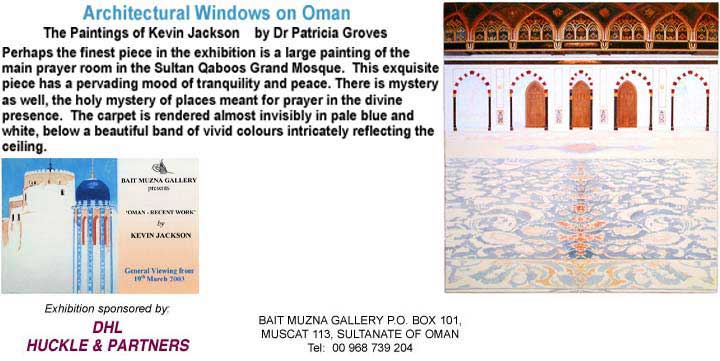
The Paintings of Kevin Jackson We first saw the paintings of Kevin Jackson almost a year ago at an informal exhibition at the British Ambassador's residence. I remember striking works with flashes of strong colour, drenched in the exotic atmosphere of faraway places.And now, here we are in Oman and the mood is utterly different. Looking at each painting is as if to open a door to find, up-front, a captured freeze frame of peaceful, emblematic architecture. It is thoroughly Omani. In this exhibition there is not a single wadi, beach, or pure landscape. I do not remember seeing the sea and hardly a mountain, but yet this is unquestionably and quintessentially Oman. Jackson has done it all through architecture. Kevin Jackson explains that when he came to Oman he was "astonished" at how different the country was from other places he had been painting in this part of the world (Morocco, Syria, Turkey), and how visually stimulating Oman is. He found it intensely exciting. There was overwhelming choice. Jackson wanted to capture the essence of Oman, without working on the superficial level of beautiful scenery. He found himself concentrating on buildings . . . sitting before a building meditatively, he would find very soon a painting appearing fully formed. He would seldom sketch in detail what he saw, but rather would make extensive notes on his feelings, on the mood of the scene and on the vision and design structure of the work. He would photograph details which were to appear in the painting. The works were to be executed not in situ, but in his studio in London. Thus were created, in seven or eight months, almost forty new visions of Oman. Jackson chose architecture as his medium because of its immense evocative capacity, "We react to the buildings we create . . . not just the great monumental architecture, but the vernacular, the buildings we live in, the way we use them, not just the culture represented in a building, but what the building means to us in ordinary use, how it is part of the lives we live in our time". Perhaps the finest piece in the exhibition is a large painting of the main prayer room in the Sultan Qaboos Grand Mosque. This exquisite piece has a pervading mood of tranquility and peace. There is mystery as well, the holy mystery of places meant for prayer in the divine presence. The carpet is rendered almost invisibly in pale blue and white, below a beautiful band of vivid colours intricately reflecting the ceiling. Jackson says the painting is "unfinished"; he is not sure why. Perhaps it has something to do with the overwhelming beauty and newness of the Grand Mosque and how difficult this is to express in the mere medium of painting. Jackson's architectural portrait of Jabreen Fort Place is highly original. The viewer is confronted with the fort's massive creamy walls blocking out the sky, yet made fragile by a fringe of shadowy white date palms etched along the bottom like ghosts. A painting entitled "Wahibi Wall", rendered all in desert-reds consists of a courtyard wall seen from the inside. The focus is on a painted gate in black and red, very plain, typical. Behind the wall, is another wall, this time made of sand, for the further wall is the all-encompassing desert. Do not miss this interesting exhibition which will be at the Bait Muzna Gallery in old Muscat until 29th March. Dr Patricia Groves 2003 |
. . . . p a g e s . u n d e r . c o n s t r u c t i o n . . . .

 |
 |
 |
 |
 |
 |
| BACK | TOP |  |
|